


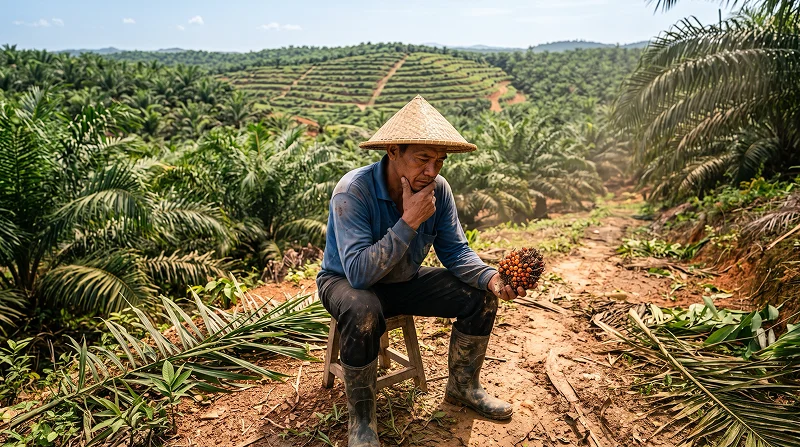
Indonesia has millions of hectares of oil palm plantations and is home to one of the world’s largest palm oil industries. However, the extensive plantation area does not automatically translate into high productivity per hectare. Data from the Indonesian Oil Palm Plantation Fund Management Agency (BPDPKS) in 2025 showed that Indonesia’s oil palm productivity stood at around 3.61 tons per hectare, still below Malaysia’s approximately 4.02 tons per hectare. This indicates that there is still room to improve the productivity of Indonesia’s oil palm plantations.
Improving productivity becomes increasingly important when expanding plantation areas is no longer the only way to increase production. Making better use of existing land requires more effective plantation management. In practice, oil palm productivity is influenced by various factors, ranging from soil and climate conditions, plant varieties, and topography to cultivation practices.
Conditions can also vary from one plantation to another. Topography, for example, can affect the availability of water and nutrients for plants. A study conducted across different topographical conditions found an average productivity of 21.23 tons of Fresh Fruit Bunches (FFB) per hectare per year on flat to undulating land, while hilly land without terraces produced 14.62 tons of FFB per hectare per year. The difference was partly associated with the risk of erosion and nutrient loss on steeper land.
Fertilization is another aspect that can be optimized as part of plantation management. Fertilizer application needs to be adjusted to the plants’ nutritional requirements and the conditions of the plantation. Unbalanced or ineffective fertilization can result in some nutrients not being optimally available to plants. Environmental conditions such as rainfall can also affect nutrient availability and uptake. Research shows that both excessive and insufficient rainfall can disrupt the growth and production of oil palm.
Therefore, meeting the plants’ nutritional requirements needs to be part of a strategy to maintain productivity, particularly when plants enter the fruit formation and development stages. During this phase, nutritional and nutrient requirements need to be carefully considered to support optimal bunch formation and fruit development.
These nutritional requirements are among the considerations behind PT Weha Agro Sejahtera’s development of Nagaemas NPK fertilizer. The product is available in three formulations designed to meet nutritional requirements at different stages of plant growth. Nagaemas Hijau, with an NPK formulation of 16-16-16, supports vegetative growth, particularly of the roots, stems, and leaves. As plants transition toward the production stage, Nagaemas Biru, with a 12-12-17-2 formulation, contains higher levels of Potassium (K) to support continued growth and plant readiness. Meanwhile, Nagaemas Merah, with a 13-6-27-4 + 0.65B formulation, is intended for the generative phase, with higher Potassium content and added Boron (B) to support fruit bunch formation and yield quality.
Oil palm productivity is not determined by a single factor. Soil conditions, plants, climate, and plantation management all need to be considered as part of a broader approach. For farmers, understanding plant requirements and providing the right nutrients is an important step toward optimizing the production potential of their plantations. Through Nagaemas NPK fertilizer, Weha provides precise fertilization formulations and consistent quality to help farmers optimize oil palm productivity.