


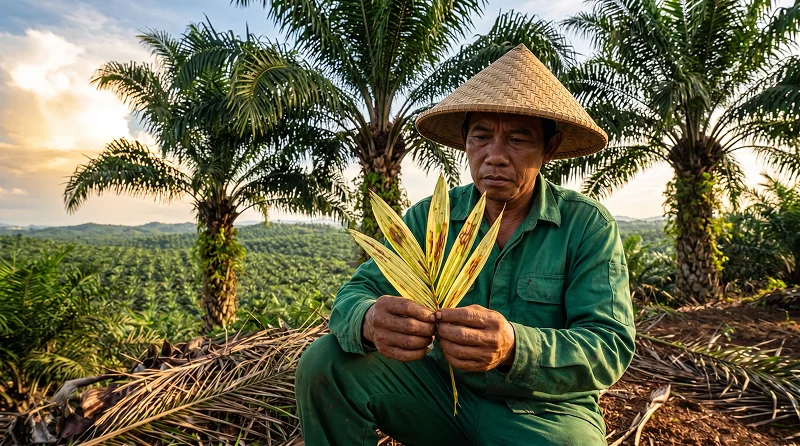
Leaves serve as one of the plant parts that can provide insight into growth conditions. This also applies to oil palms. Healthy oil palm plants generally feature dark green and robust leaves. Conversely, changes in color or shape can indicate that the plant is experiencing issues, including when its nutritional needs are not being met.
One of the easily recognizable symptoms is leaf discoloration to pale or yellowish tones. This symptom can relate to conditions where the plant lacks certain essential nutrients. Nitrogen (N) deficiency, for instance, can cause leaves to turn from green to pale or yellowish. Magnesium (Mg) deficiency can also trigger color changes in older leaves to become yellow and dry, while potassium (K) deficiency is often marked by the appearance of spots on the leaves. Meanwhile, boron (B) deficiency can affect the shape and development of young leaves, making them shorter.
Nutritional issues of this nature were detailed in research conducted by a team of domestic and international researchers across 973 smallholder fields located throughout major oil palm producing regions in Indonesia. Published in the journal Agricultural Systems in 2023, the study revealed that potassium deficiency was present in 88% of the surveyed fields. Nearly two-thirds of the fields also suffered from nitrogen and boron deficiencies, about half experienced phosphorus deficiency, and roughly one-third lacked magnesium. Furthermore, the study noted widespread nutrient imbalances across many of these plantations.
These findings help explain why plants may still exhibit suboptimal growth despite regular fertilization. Another study focusing on 49 smallholder oil palm plots in Indonesia (24 in Sintang, West Kalimantan, and 25 in Jambi) indicated that fertilization practices often failed to align with actual crop requirements. Nutrient deficiencies, particularly in potassium and phosphorus, were estimated to contribute to vegetative growth falling below optimal levels. Additionally, single leaf areas were found to be smaller than expected in over 80% of the investigated plantations.
These two studies demonstrate that successful fertilization cannot be measured solely by the frequency or volume of fertilizer applied. The specific types and balance of nutrients require careful attention. Plants need nutrients in proper amounts and proportions to support the growth of roots, stems, and leaves. Applying unbalanced nutrients can leave certain plant requirements unmet while supplying other elements in excess.
Such requirements served as a key consideration for PT Weha Agro Sejahtera in developing NPK Nagaemas. To support vegetative growth, Nagaemas Hijau offers an NPK 16-16-16 formulation with a balanced nutrient composition intended to foster root, stem, and leaf development. Nagaemas is also produced as a granular NPK fertilizer featuring controlled nutritional formulations and physical quality to ensure consistent product performance.
When oil palms fail to grow optimally despite ongoing fertilization, evaluating the crop's nutritional needs becomes essential. Understanding nutrient requirements and maintaining balance can help growers determine more precise fertilization strategies. Supplying appropriate nutrition allows the growth of roots, stems, and leaves to be supported far more effectively.